You didn't deploy software. You hired a workforce.
And nobody is managing it.
Your team picked a model, wired some tools, shipped an agent. Then it stalled. That is not a model problem. It is a management problem, and it has seven named causes.
Scroll to assemble the stack
Everyone already solved this one.
Choosing a model is procurement, not strategy. Your competitor has access to the same weights you do, on the same day. Whatever advantage you think lives here, it does not. This is the only layer most companies ever finish, which is exactly why it cannot be where the value is.
Solved in most organizationsAn agent that only works when someone is watching is a demo.
The harness is what actually executes: unattended, on a schedule, surviving a crash, resuming where it stopped, reporting when it is done. Most teams have a script and a person who reruns it. That person is the harness, and they do not scale.
Fragile in most organizationsOne agent is a script. Many agents are an organization.
Real work is decomposed, fanned out to specialists, gated at the points that matter, and reassembled. The moment you need two agents to cooperate you need the same primitives every engineering organization already has: division of labor, handoffs, review, and a definition of done.
Missing in most organizationsYour agents have amnesia, and you are paying for it every session.
What persists, what is scoped to one task, what is shared across the fleet. Without this, every run rediscovers your codebase, your conventions, and your last three decisions from scratch. You are not buying intelligence. You are re-buying context, forever.
Missing in most organizationsYour institutional wisdom should be a Git repo.
Every company keeps its judgment in people's heads, in Slack threads, in a deck nobody opens. That is why your agents behave like contractors on day one, forever. Wisdom that is not versioned, reviewed and diffed is not an asset. It is a rumor. This is the layer nobody has even named, and it is the one that compounds.
Unnamed in most organizationsAccess without blast radius is not capability. It is exposure.
What your agents can touch, what they can change, and what happens when they are confidently wrong. Every team wires tools. Almost none of them can answer what a bad run costs, or draw the boundary they would defend to their own security officer.
Ungoverned in most organizationsAgents that cannot talk to each other are just parallel scripts.
How work is handed off, how results are challenged, how one agent catches what another confidently got wrong. Verification between agents is the difference between a fleet that compounds accuracy and a fleet that compounds mistakes at speed.
Missing in most organizationsThe maturity ladder
Six levels. Most organizations are at L1 and believe they are at L3.
Every level above the one you are on changes what your company can do, not just how fast it types. This is the climb, and where two days moves you along it.
Two days in the lab moves a team from L1 to L4.
Assisted
Copilot in the editor. Individual engineers are genuinely faster, but the gain lives and dies with each person.
Your engineers are faster. Your organization is not.
Not sure which level is yours?
Talk to our agent for four minutes. It asks six questions, a second agent scores the transcript against the seven layers, and you get your placement by email.
The case study


Nine people. Enterprise reach.
We are not teaching this from a whitepaper. INFINITEWARE runs the function surface of a large enterprise with nine full-time people directing more than seventy specialist agents across eight standing business functions, with independent verification and continuous coverage.
The platform below is the one we operate the company with. In the lab we open it up, including the parts that broke on the way.
Read the field studySymbiote
Our orchestrator
Not a chat window with a company attached. Symbiote is the layer the fleet actually runs on - memory, harness, autonomy, tools and the rig underneath - and it is the same software we open up in the lab.
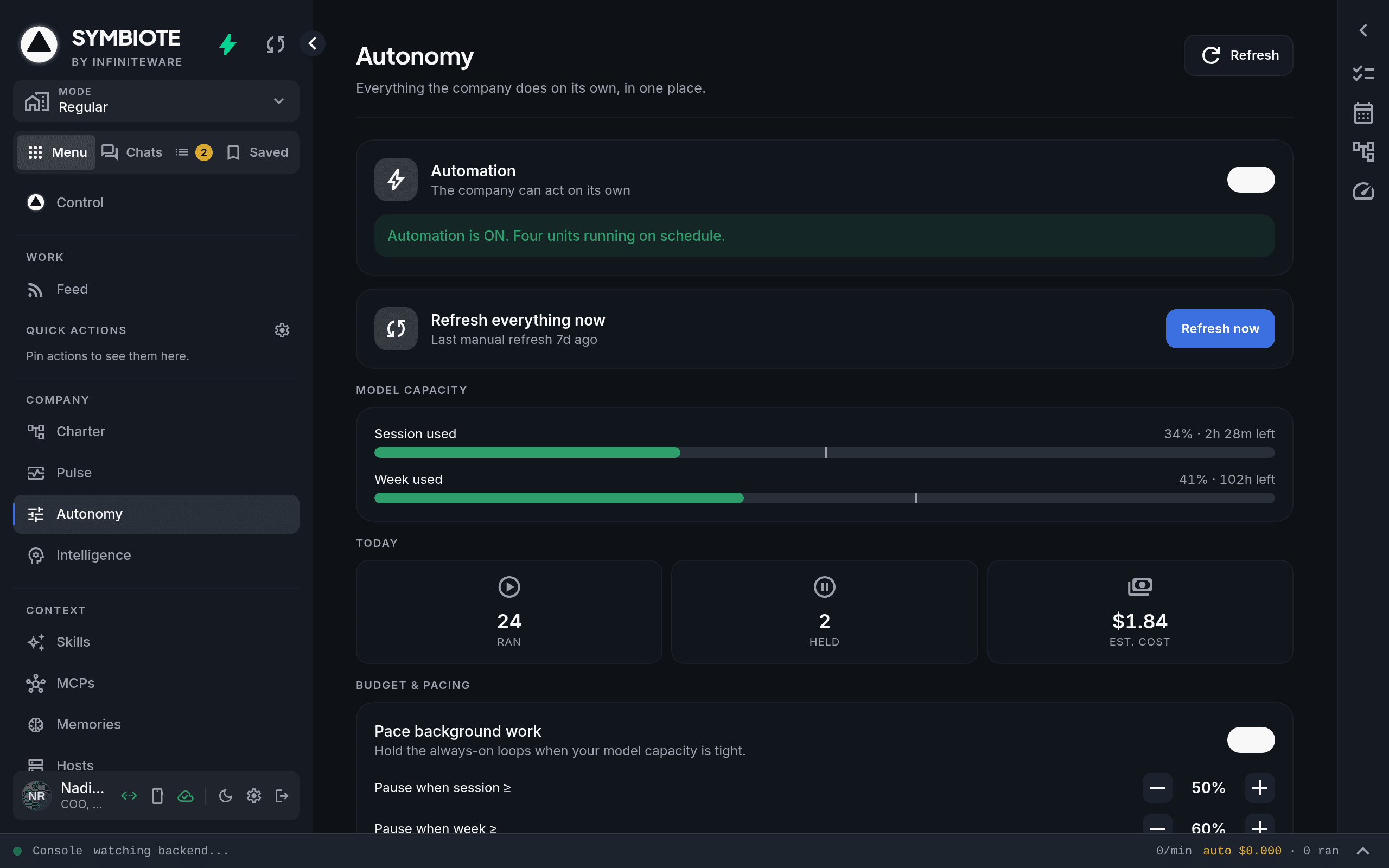
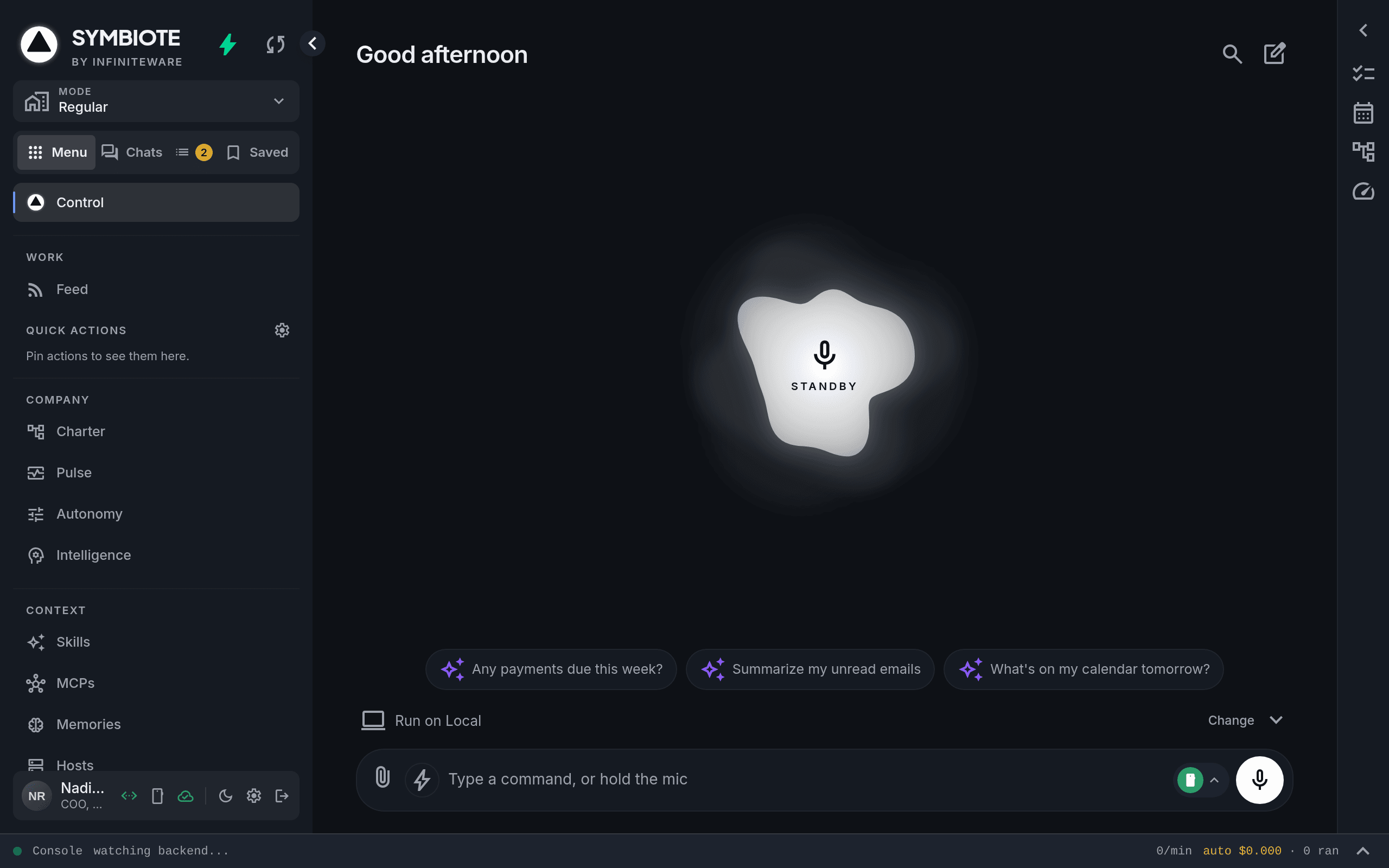
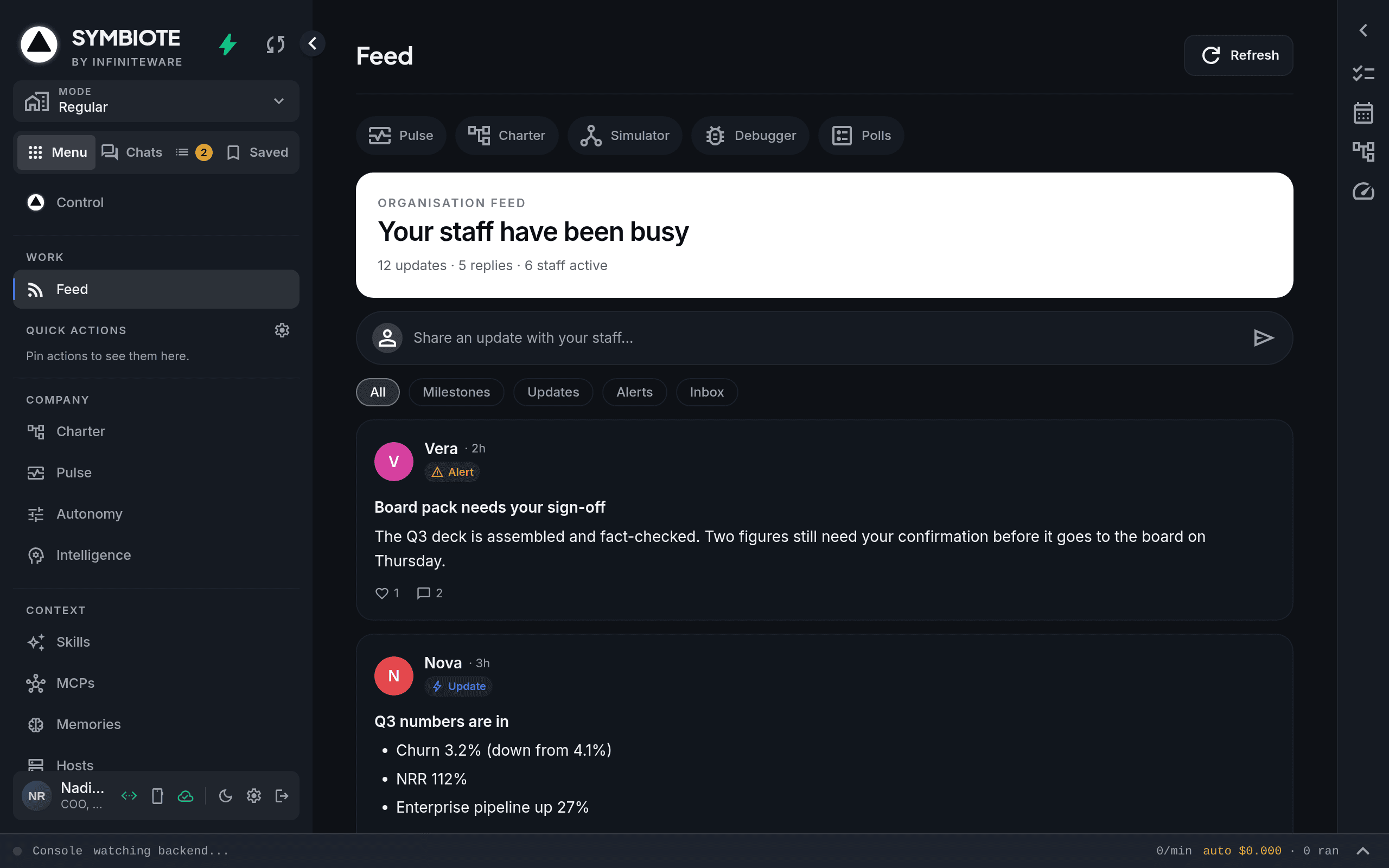
Screens from the INFINITEWARE product, shown as published.
Nobody storyboarded these.
These four films were made for a talk we gave to the Rotary Club. The brief went into the media function and the finished loops came back out - concept, shot list, generation, grade and cut. No designer opened a timeline.
That is the point of the layers. A function you can hand a brief to is not a faster prompt. It is a part of the company that runs whether or not you are watching.
Produced by the INFINITEWAREmedia function, August 2026
The assembled stack
Two days. Your repo. Your fleet running by the end of it.
Your engineers leave with their own orchestration harness wired to their own repository, a memory and wisdom layer seeded with your actual context, a tool-permission model they can defend to security, and a written assessment of where you sit and the next three moves.
- Capped at 16 seats, maximum two per company
- Admission by application. Everyone in the room is building
- Led by Ameen Altajer, Google Developer Expert
- Built on infrastructure INFINITEWARE runs its own company on
Team Seat
$2,500One engineer, both days, the full artifact kit.
Squad
$8,000One company, four engineers at $2,000 each, plus a private pre-lab diagnostic call.
Private In-House
From $30,000Two days on site, your repositories, your security model, plus 30 days of follow-up support.
A mid-level engineer costs ~$40,000 a year
Who we work with
Trusted where the stakes are real.
Energy, sovereign funds, central banking, telecom and government. Organizations that do not hand their systems to people who are still figuring it out.
















A selection of INFINITEWARE clients across engagements
Everyone in the room is building.
The application is the filter. We read every one, and we turn down anyone who has not shipped something with a model yet, because the room only works if the whole cohort can keep pace.
- Company email only, so we know who we are talking to
- 16 seats per cohort, maximum two per company
- A reply within five working days, either way
Not ready to apply? Find out where you actually sit first.
Find your level